
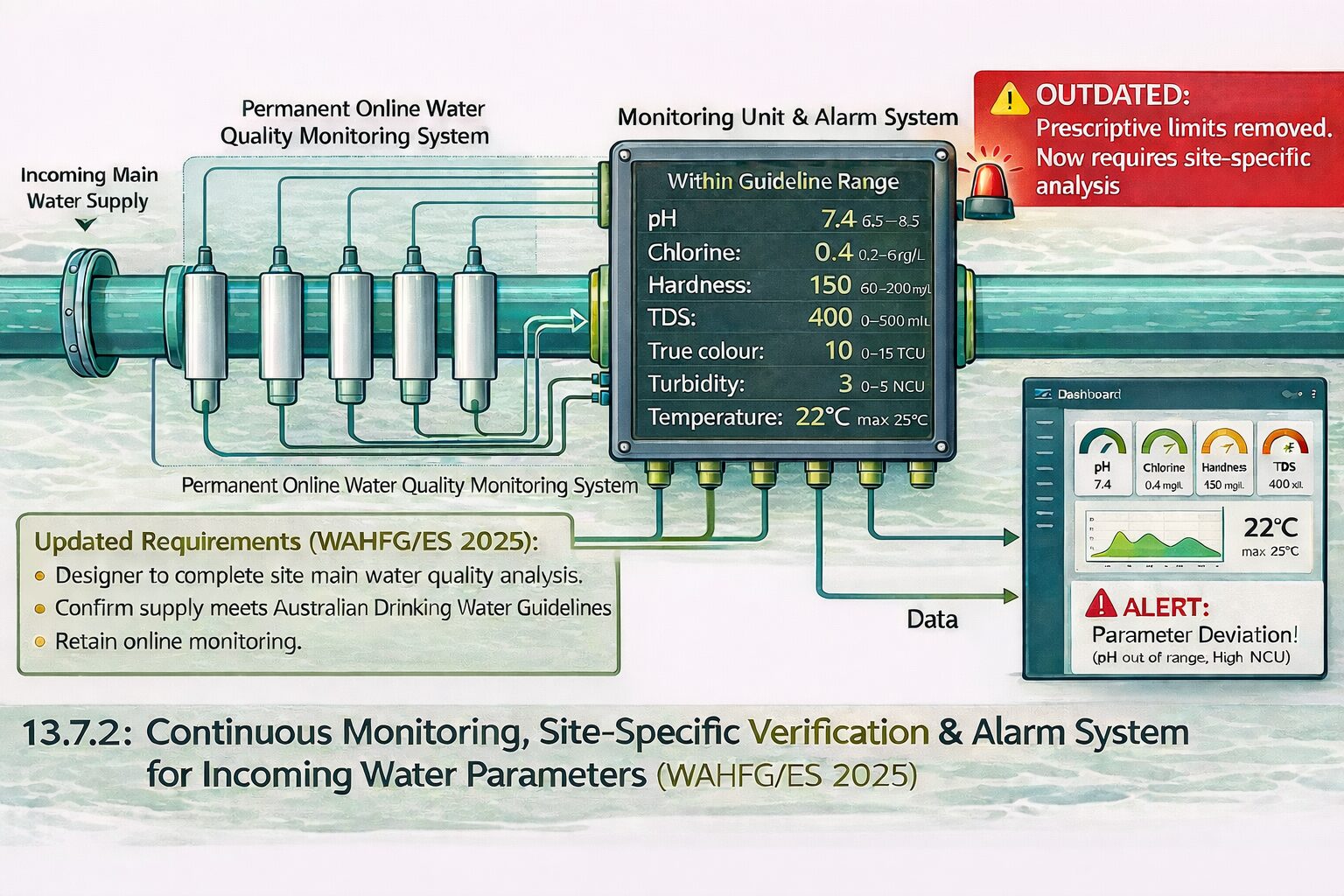
Example layout of incoming mains water monitoring and alarms referenced in WAHFG/ES 2025 (Section 13 – Hydraulic).
What is WAHFG/ES 2025 and who does it apply to?
WA Health has finalised and published the Western Australia Health Facility Guidelines for Engineering Services 2025 (WAHFG/ES 2025). WA Health notes the guidelines apply to new building projects seeking Approval in Principle (AIP), and that they are a mandatory reference for proponents, engineers and assessors in the private healthcare facilities approval pathway.
WA Health has also provided a three month grace period for new AIP submissions, where proponents may have the option to be assessed against WAHFG/ES 2021 or WAHFG/ES 2025, with the grace period ending 30 April 2026 (case by case assessment).
The key change: from prescriptive limits to evidence-based water quality verification
In the previous edition, Section 13 included a prescriptive table of “acceptable parameters” for incoming mains water (often shared internally as a quick reference). In the 2025 update, those specific numeric limits have been removed and replaced with a requirement for the designer to complete a site main water quality analysis to confirm the incoming supply meets the minimum standards set out in the Australian Drinking Water Guidelines (ADWG).
This is a meaningful shift in approach:
- Prescriptive limits can be easy to apply, but they don’t always reflect local supply conditions or site-specific risks.
A baseline analysis creates a defensible evidence trail: what the site receives, how it compares to the guideline framework, and what control measures are appropriate.
What stayed: online monitoring still matters
The updated guidance continues to require permanent online water quality monitoring on the incoming main supply (connected to the building management system), reinforcing that verification is not a one-off exercise. The operational value is simple: early detection of water quality changes supports timely response, protects infrastructure performance, and reduces downstream risk.
A related change that carried over into WAHFG/ES 2025: UV after tanks is no longer prescriptive
In the previous update (prior to the 2025 release), prescriptive reference to UV (ultraviolet) disinfection after tanks was removed. WAHFG/ES 2025 continues that direction, reinforcing a shift away from fixed “one-size” inclusions and toward selecting controls based on site-specific risk and system performance.
This matters operationally because UV can be a useful barrier in some contexts, but in chlorine-dosed systems it can also reduce disinfectant residual if not designed and integrated appropriately. Moving away from prescriptive UV inclusion supports a more defensible approach where treatment is selected to suit actual water quality, system design, and the intended control strategy.
The practical takeaway for project teams is that water treatment should be specified based on supplier/designer best practice and site conditions, and then verified through commissioning and operational monitoring.
Small addition to “Practical steps” (unchanged from prior suggestion, still valid)
Under “Plan the incoming mains water quality analysis early”, add:
Confirm treatment philosophy early (including UV where relevant).
If treatment is required, ensure it is selected to suit the site and avoids unintended interactions (for example, UV and disinfectant residual management in chlorine-dosed systems).
What’s been strengthened: clearer alignment to standards and health guidance
WAHFG/ES 2025 also strengthens its references for water supply compliance, including:
- • Australian Drinking Water Guidelines (ADWG)
- • enHealth (health guidance relevant to water systems in buildings and public health risk management)
- • AS/NZS 5369 (where relevant to your project’s scope)
- • ASTM D1193-06 (where required)
For project teams, the practical takeaway is to treat water quality verification as a standards-aligned design input, not an afterthought.
Practical steps for WA hospital project teams
If you’re working on WA healthcare builds or refurbishments, consider building these steps into your design and commissioning workflow:
1. Confirm which edition applies
If you’re submitting for AIP during the transition window, confirm assessment expectations early (and document the basis). WA Health outlines the grace period and AIP applicability in the release communication.2. Plan the incoming mains water quality analysis early
Do this early enough to influence decisions on:
• treatment needs (if any)
• materials compatibility and corrosion/scaling risk
• monitoring points and alarm setpoints
• commissioning and operational handover documentation
3. Translate results into operational controls
The goal isn’t a lab report; it’s better decisions:
• What should be monitored online?
• What constitutes “normal” for this site?
• What triggers investigation/escalation?
• Who owns response actions?
4. Document compliance clearly
Where guidelines point to ADWG and other references, ensure the project record shows:
• what was tested
• when and where samples were taken
• how results were interpreted against the applicable guidance
• what design/operational controls were selected as a result
Upcoming information sessions
WA Health has advised two information sessions for stakeholders: 18 March 2026 and 26 March 2026 (5:30pm), with queries and registration via the WAHFGEngineering contact.
How Ecosafe International can support
Ecosafe supports healthcare and infrastructure teams with independent, evidence-based water risk and water quality programs across design, commissioning and operations – helping translate guideline requirements into practical monitoring, verification and documentation that supports patient safety and reliable water systems.
Next step: If you’re working on a WA healthcare project under AIP, align early on the edition being assessed, then plan your incoming mains analysis and monitoring strategy as an integrated package (not separate tasks).